
In 2025, if you’re not dialed into digital marketing, you’re leaving money on the table. The industry is booming. The U.S. roofing market hit $60 billion last year, and it’s growing, but so is the competition. Homeowners are searching online more than ever, especially after a storm or for routine repairs.
In this article, I’m breaking down the five powerhouse online channels that actually move the needle for roofers: SEO, PPC (think Google Ads), Local Service Ads, Directory Listings, and Google Business Profile. I’ll hit you with real costs, lead potential, and results based on fresh 2025 data. No fluff, just straight talk on what works, what it costs, and how to make it pay off. We’ll compare them head-to-head at the end so you can mix and match for your setup. Let’s dive in and get your business climbing those search rankings.
SEO: The Long-Game Lead Machine
SEO (Search Engine Optimization) is the process of tweaking your website and online presence so that when someone in your area Googles “roof repair near me” or “best roofer in [your city],” your business shows up on the first page – for free, ongoing. It’s like owning prime real estate on Google instead of renting it.
This is my bread and butter because it’s like building equity in your business. Instead of paying for every click, you’re optimizing your website and online presence so Google sends free traffic your way. For roofers, it’s all about local SEO: targeting searches like “roof repair near me” or “best roofer in [your city].”
Costs
Expect to invest $750–$1,000 per month for entry-level setups in low-competition markets, jumping to $1,200–$2,000 for most established roofers. In competitive urban areas, it can hit $2,500–$5,000 monthly. That’s for agency help. If you’re DIYing, it’s mostly time, but you’ll need tools like Ahrefs or SEMrush ($100–$300/month). Upfront costs for site audits or content creation? Add $1,000–$3,000 to get rolling.
Leads Potential
Once optimized, SEO can deliver 20–75+ high-quality leads per month, depending on your market size and how aggressive you are. I’ve seen clients go from zero organic traffic to 50+ leads monthly within 6–9 months. Cost per lead (CPL) drops to $3–$5 over time, way cheaper than paid ads. Compare that to traditional marketing’s
1–2x ROI – SEO often hits 8–9x once mature.
Pros: Builds long-term authority, attracts ready-to-buy homeowners (high conversion rates of 5–10%), and compounds over time. In 2025, with Google’s AI updates, quality content like blog posts on “storm damage repair tips” is key.
Cons: It’s slow, results take 3–12 months, and you need consistent effort on keywords, backlinks, and mobile-friendly sites. One client of mine, a mid-sized roofer in Texas, saw a 300% traffic spike after optimizing for local keywords, turning into $150K in extra revenue yearly. But if you’re in a saturated spot like NYC, pair it with other channels for quicker wins.
Tip from me: Focus on local packs, claim your Google Business Profile (more on that later), and get 50+ reviews. Track with Google Analytics; aim for under $50 CPL to start.
PPC: Fast Leads, But Watch the Wallet

PPC (Pay-Per-Click) advertising, mainly through Google Ads, lets you buy the top spots on Google search results. You only pay when someone actually clicks your ad – perfect for getting your phone ringing right away during slow periods or after a big storm.
PPC is your quick-hit option. You bid on keywords like “emergency roof repair” and only pay when someone clicks. Great for storm seasons or filling slow months.
Costs
Average CPC for roofing keywords is $20–$30, but in hot markets, it climbs to $50–$150 per click. Overall, Google Ads CPC in 2025 is $4.51–$5.26, but roofing skews higher due to competition.
Monthly budgets? Start at $1,500–$2,000 for small campaigns, up to $3,500–$7,000 for bigger ones. Agency management adds 15–20% fees.
Leads Potential
With a 5% conversion rate, expect CPL of $150–$400. In good setups, you could snag 10–50 leads monthly per $2K spend. Average Google Ads CPL is $70, but for roofers, it’s higher, think $150+. High-intent traffic means close rates of 10–20%.
Pros: Instant visibility, geo-targeting keeps it local, and you can scale during peaks. A Raleigh roofer I worked with generated $10K+ in leads monthly with targeted ads.
Cons: Costs add up fast if bids are mismanaged. I’ve seen guys burn $5K with zero ROI from bad keywords. In 2025, use negative keywords (e.g., block “DIY roof repair”) and geo-fencing to avoid waste. ROAS (return on ad spend) can hit 4–6x if your landing pages convert well.
Tip: Set a max budget and track conversions religiously. Test ad copy like “24/7 Emergency Roofing – Free Quote Now” for better clicks.
Local Service Ads: Pay for Leads, Not Clicks
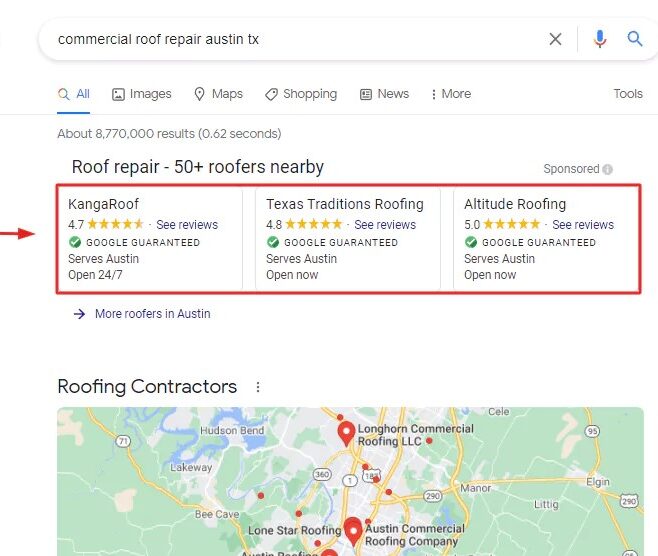
Google Local Service Ads (LSAs) put your business at the very top of search results with a “Google Guaranteed” badge. You don’t pay for clicks – you only pay when a real customer contacts you directly through the ad (call or message).
Google’s Local Service Ads (LSAs) are a game-changer for service pros like us. They show up at the top of searches with a “Google Guaranteed” badge, and you pay only for verified leads – calls or messages.
Costs
Pure pay-per-lead: $75–$150 CPL for roofing. No upfront fees beyond setup (free to join, but background checks cost $50–$100). Budgets flex with lead volume – aim for $1,000–$3,000 monthly in moderate markets.
Leads Potential
High-intent: 10–30 leads monthly, with conversion rates up to 20–30% since leads are pre-screened. Better than shared directories because they’re exclusive.
Pros: Builds trust with the Google badge, lower CPL than standard PPC, and focuses on local searches. One client dominated their area, getting 25 leads/month at $100 each, closing half.
Cons: Limited availability in some markets, and you compete for top spots based on reviews/response time. In 2025, LSAs outperform shared leads for most roofers. Volume can be lower, but quality higher, think fewer tire-kickers.
Tip: Respond to leads in under 5 minutes and rack up 4.5+ star reviews to rank higher. Integrate with your CRM for tracking.
Directory Listings: Quick Setup, Steady Drip
These are online directories like Angi, Yelp, HomeAdvisor, or Thumbtack, where homeowners go to find and compare local roofers. You create a profile, add photos and reviews, and customers can contact you directly or request quotes. You list your business, often for free, but pay for premium features or leads.
Costs
Free basic listings; paid leads range $13–$72 each, depending on service and platform. Premium directories like Angi charge $300–$500/year for enhanced visibility. Overall, CPL around $50–$150.
Leads Potential
5–20 leads monthly from top directories, but they’re often shared (multiple pros get the same lead). Conversion: 5–15%, as competition is fierce.
Pros: Easy entry, builds citations for SEO boost, and good for brand awareness. Top picks for 2025: Angi, HomeAdvisor, and Yelp for local focus.
Cons: Leads can be low-quality or overpriced if not vetted. I’ve had clients waste time on shared leads that go nowhere. ROI is solid (2–4x) if you respond fast and have strong profiles.
Tip: Claim listings on 20+ sites (use tools like Moz Local, $100/year) and encourage reviews.
Google Business Profile: Your Free Local Powerhouse
Your Google Business Profile (formerly Google My Business) is the free business card that shows up on Google Search and Maps when people look for roofers nearby. It includes your hours, photos, reviews, and a button to call or get directions – often the first thing customers see.
This is your free listing on Google Maps and search. Optimize it, and you’ll show up in the “local pack” for nearby searches.
Costs
Zero dollars – it’s free. Optimization might cost $200–$500 one-time for pro help, or DIY with time.
Leads Potential
Huge: 20–50+ leads monthly from local searches alone. With reviews, calls increase 30–50%. It’s the foundation for other channels.
Pros: Boosts visibility in Maps (70% of local searches), drives direct calls/website visits. An optimized profile with photos, services listed, and 100+ reviews can double leads.
Cons: Requires ongoing maintenance (respond to reviews, post updates). In 2025, AI features like auto-response,s help, but neglect it, and you drop rankings.
Tip: Add high-res photos of jobs, list all services (e.g., metal roofing), and aim for 5 new reviews monthly. Track insights in the dashboard.
Head-to-Head Comparison: Which Channel Fits Your Roofing Biz?
To make this easy, here’s a quick table comparing the biggies based on 2025 data. Remember, your market matters – test small and scale.
| Channel | Avg. Monthly Cost | CPL Range | Leads/Month Potential | Speed to Results | Best For |
| SEO | $1,000–$5,000+ | $3–$50 | 20–75+ | 3–12 months | Long-term growth |
| PPC | $1,500–$3,500 | $150–$400 | 10–50 | Immediate | Quick boosts |
| Local Service Ads | $1,000–$3,000 | $75–$150 | 10–30 | 1–4 weeks | High-intent locals |
| Directory Listings | $300–$500 (premium) | $13–$72 | 5–20 | 2–6 weeks | Easy entry |
| Google Business | Free | N/A (free traffic) | 20–50+ | 1–3 months | Local visibility |
From my experience, SEO + Google Business is the unbeatable duo for sustainable leads (80% of my clients’ strategies). Add PPC/LSAs for storms.
For Overall ROI? Aim for 3–5x across channels – track with tools like CallRail.
Wrapping It Up: Build Your Marketing Roof Strong
Online channels aren’t “set it and forget it.” But combine these five wisely, and you’ll see steady leads without breaking the bank. Start with Google Business (it’s free!), layer in SEO for longevity, and use PPC/LSAs for spikes. Budget 5–10% of revenue on marketing.